Making 20,224 hidden microexons searchable
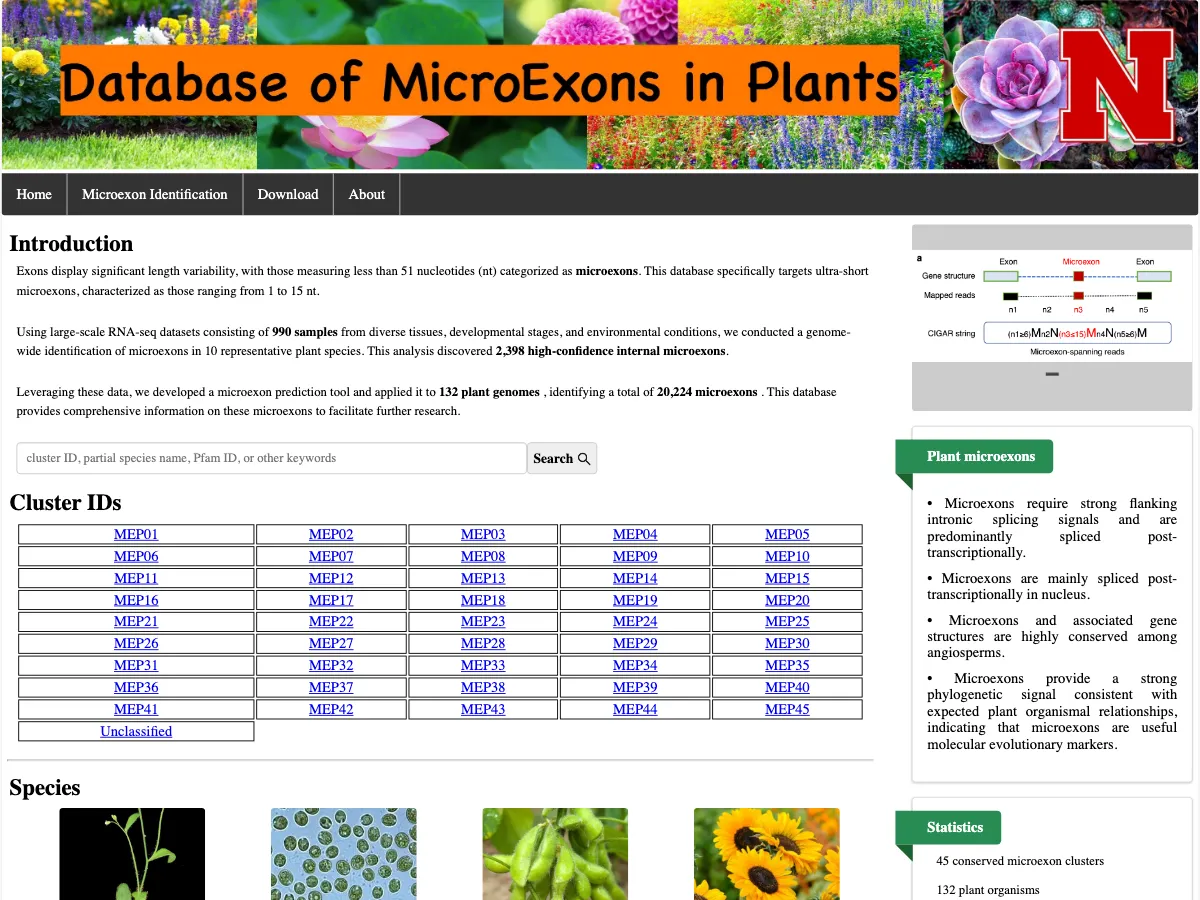
I built the MySQL database and PHP web app behind MEPDB, a public, peer-reviewed resource for plant exons of 51 nucleotides or fewer across 132 genomes.
- 20,224
- microexons served
- 132
- plant genomes covered
- 51
- nucleotides or fewer, the size that makes them easy to miss
At a glance
- Role
- Undergraduate Researcher, Database & Web Development
- Organization
- Center for Plant Science Innovation, University of Nebraska–Lincoln
- Dates
- February 2024 – present
- Status
- Published, publicly available
- Stack
- MySQL · PHP · JBrowse 2 · JavaScript · LAMP
- Hard skills
- SQL · PHP · JavaScript · MySQL schema design · JBrowse 2 integration · LAMP stack
- Soft skills
- Working inside a research group's method · Building for users outside the lab
- Why it matters
- Plant labs can search and download 20,224 microexons themselves instead of working from a supplementary table.
Problem
A microexon is an exon of 51 nucleotides or fewer. The shortest are only 1 to 15 nucleotides long. At that length, standard genome annotation routinely misses them. Most of the ones this project found were not annotated in the reference genomes at all, which left them invisible to anyone downstream who might have studied them.
The group’s prediction method found 20,224 of them across 132 plant genomes. At that scale the findings become an infrastructure problem. Nobody can use twenty thousand coordinates in a supplementary table.
What I built
The prediction method and the biology are the group’s work, and the paper has four authors. My part was the database and the web app on top of it: the MySQL schema, the PHP back end, the JBrowse 2 integration, and the search and download tools.
For each microexon, the database holds genomic coordinates, nucleotide and amino-acid sequences, the related gene annotations and corrected CDS information that reflects the new annotation. JBrowse 2 feature tracks, which I set up in JavaScript, show each microexon in its genomic context instead of as a row of coordinates.
All of it is searchable across the 132 genomes and exportable in bulk, because a researcher’s next step is almost always to pull a subset into their own pipeline.
How I checked it
The strongest checks came from outside the lab. The paper describes the database itself, and it went through peer review at New Phytologist before publication. Research groups outside the lab now use its search and download workflows.
What happened
MEPDB was published in New Phytologist in 2025 (volume 248, pages 32 to 37), with me as co-first author. On the public site, anyone can look up a microexon, see it in its genomic context and download its sequences and corrected CDS.
Evidence
- MEPDB: Database of microExons in plantsNew Phytologist 248(1), 32–37 (2025). Peer-reviewed, co-first author.
- MEPDB live site